The Laundry Test: A No-Nonsense Formula for Figuring Out Exactly How Many Basics You Need
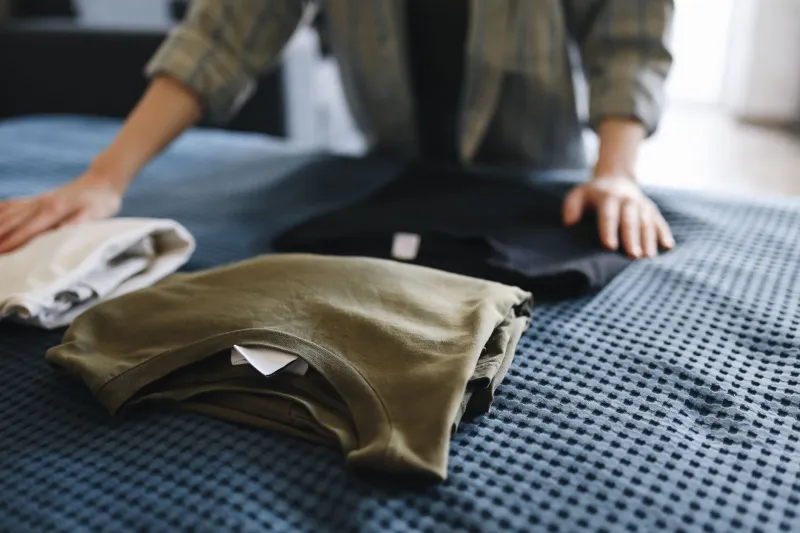
Here's a question no capsule wardrobe guide has ever asked you: when did you last do laundry?
Not in a judgmental way. In a genuinely practical one. Because the number of basics you need — white tees, neutral trousers, everyday bras, work-appropriate blouses — is not determined by some universal rule or a lifestyle blogger's ideal closet. It's determined, more than anything else, by how often you wash your clothes.
And yet almost every wardrobe guide skips this entirely.
The Variable Nobody Talks About
Capsule wardrobe advice tends to operate in the abstract. Ten tops, five bottoms, three pairs of shoes. Clean, tidy, aspirational. What it never accounts for is the fact that your laundry situation is deeply personal and wildly variable.
Maybe you have an in-unit washer and dryer and run a load every few days. Maybe you're hauling your clothes to a laundromat on Sunday afternoons once a week. Maybe you live in a building with a shared machine that's perpetually in use, so you realistically wash every ten to fourteen days. Maybe you're somewhere in between, depending on the season and your schedule.
Each of those scenarios requires a completely different number of basics. And until you account for your actual laundry frequency, any number you're told to own is essentially a guess.
Step One: Know Your Laundry Cycle
Before you count a single piece of clothing, establish your baseline. Ask yourself honestly: how many days pass between the moment you put something in the laundry hamper and the moment it's clean and back in your closet?
This isn't just wash day — it's the full cycle. If you wash on Sunday but don't fold and put away until Tuesday, your effective turnaround is two days, not one. If you drop things at a wash-and-fold service on Monday and pick them up Wednesday, that's a two-day cycle with zero effort but real time cost.
For most working professionals in the US, the realistic laundry cycle falls somewhere between 5 and 14 days. Let's use that range to build our formula.
The Basic Formula
Here it is, unsexy as it sounds:
Number of a basic item you need = (Days in your laundry cycle) + (1 buffer item)
The buffer exists because laundry day doesn't always happen exactly on schedule. Life gets in the way. The buffer means you're never scrambling.
So if your laundry cycle is 7 days, you need 8 of any daily-use basic. If it's 10 days, you need 11.
But wait — not every item gets worn every single day. Let's break this down by category.
Applying the Formula: Category by Category
Underwear and Bras These are your most straightforward calculation because they're (ideally) worn once per day. If your laundry cycle is 7 days, you need at least 8 pairs of underwear. Bras are worn multiple times before washing, so 3–4 rotating bras typically covers most women regardless of laundry cycle, since you're extending their wear life.
White Tees and Basic Tops Think about how many days a week you actually need a fresh top. If you work in an office four days and spend one day at home in something comfortable, you're using roughly five tops per week. On a 7-day cycle, you need 6. On a 10-day cycle, you need 11 — which is where a lot of people run short and don't realize why.
Neutral Bottoms (Trousers, Skirts, Dark Jeans) Bottoms generally get more than one wear before washing, especially structured trousers or dark denim. A realistic rewear rate is 2–3 wears per bottom. If you're wearing a bottom every workday (4–5 days per week) and getting 2–3 wears each, you need 2–3 rotating bottoms on a 7-day cycle, and 3–4 on a 10-day cycle.
Workout Clothes (If Applicable) If you exercise regularly, workout gear enters its own category — it's typically a once-and-done situation before washing. On a 7-day cycle with 5 workout days per week, you need at least 6 sets of workout clothes. Most people dramatically underestimate this number and end up doing a mid-week emergency sports bra rinse in the sink.
Climate and Season Add Variables
If you live in a humid region — say, the Gulf Coast in July — you're sweating through clothes faster. That white tee that might get two wears in October will need washing after one in August. Adjust your counts seasonally if your climate demands it.
Cold-weather dressing actually works in your favor here. Layers worn over base layers extend the life of outer pieces. A cardigan worn over a fresh blouse doesn't need washing after every wear. Winter wardrobes can often get by with fewer rotating pieces than summer ones for this reason.
The Laundromat Calculation
For anyone without in-home laundry — a significant portion of renters in cities like New York, Chicago, and LA — the calculus changes meaningfully. Laundromat trips involve time, cost, and planning. Most people doing laundromat runs go every 10–14 days, not weekly.
If that's you, run your numbers on a 12-day cycle. You likely need:
- 13+ pairs of underwear
- 12–13 basic tops
- 4–5 rotating bottoms
- Enough socks to avoid the mid-cycle desperation shuffle
This is not excessive. This is math. And it's why the "10 tops is plenty" advice can feel so frustrating when you're hauling laundry across three blocks every other Sunday.
When to Stop Buying and Start Organizing
This formula tells you the floor — the minimum you need to function without stress. It doesn't tell you to buy more than that. Once you've hit your number for each category, stop. Additional basics beyond your cycle coverage don't add utility; they add clutter.
The sensible approach: calculate your number, audit what you already own, and fill only the gaps. You may find you're already there in some categories and short in others. Most people discover they have too many tops and not nearly enough underwear, which is a very common and very fixable problem.
The Bottom Line
No wardrobe formula is universal, because no laundry situation is universal. The most elegant closet isn't the one with the fewest pieces — it's the one sized exactly to your actual life. Once you know your laundry cycle, you know your number. And once you know your number, the endless debate about how many basics you should own quietly resolves itself.
Do the math. It takes ten minutes. Your Tuesday morning self will thank you.