It's Not What You Wear — It's the Energy You Bring to It
The Expensive Outfit That Fooled Nobody
Let's be honest about something. We've all seen it — someone in a perfectly pressed blazer and tailored trousers who somehow still manages to look like they're wearing a costume. And then there's the person across the room in a $40 Old Navy cardigan who owns every inch of the space they're standing in. What's the difference?
It's not the clothes. It's the confidence gap.
This isn't just a vibe thing, either. Researchers have spent a lot of time studying what actually communicates competence in professional environments, and the results consistently point to nonverbal cues — posture, eye contact, the deliberateness of your movements — as the dominant signals people pick up on before they've processed a single word you've said. Your outfit sets a context, sure. But your body language writes the story.
What the Research Actually Says
Social psychologist Amy Cuddy's work on presence — the kind that makes people listen when you speak — found that the way we physically occupy space changes not just how others perceive us, but how we perceive ourselves. The feedback loop between body language and self-perception is real and measurable.
A 2012 study published in the Journal of Experimental Social Psychology took this further, finding that what researchers called "enclothed cognition" — the psychological effect of wearing certain clothes — only kicks in when the wearer is aware of and invested in what they're wearing. In plain English: the confidence boost from a great outfit requires you to actually believe in the outfit. Wearing something expensive that you feel uncomfortable in doesn't give you the psychological edge. Wearing something you feel genuinely good in — at any price point — does.
This reframes the whole conversation about professional dressing. The goal isn't to acquire the right pieces. It's to develop a relationship with the pieces you have.
The Authenticity Problem With "Dress for the Job You Want"
That old advice — dress for the job you want, not the job you have — has always had a flaw baked into it. It implicitly tells you to perform a version of yourself you haven't grown into yet. And performance reads as performance. People can usually tell when someone is wearing a costume versus wearing their actual style.
The professionals who consistently read as polished and competent aren't necessarily the ones spending the most on clothes. They're the ones who've figured out what works for them specifically and lean into it with intention. That consistency is what creates a style signature — and style signatures are powerful.
Think about the colleague who always wears a bold earring with otherwise minimal outfits, or the manager who never shows up without a structured bag. These aren't accidents. They're anchors. They say: I know who I am, and I dressed accordingly.
How to Build Your Own Style Signature
Developing a personal style signature doesn't require a wardrobe overhaul or a Pinterest deep-dive. It requires paying attention to what you already gravitate toward and making those choices more deliberate.
Start with your anchors. Look at the outfits in your recent memory that made you feel most like yourself — not most impressive to others, but most you. What do they have in common? A color family? A silhouette? A type of layering? That pattern is your starting point.
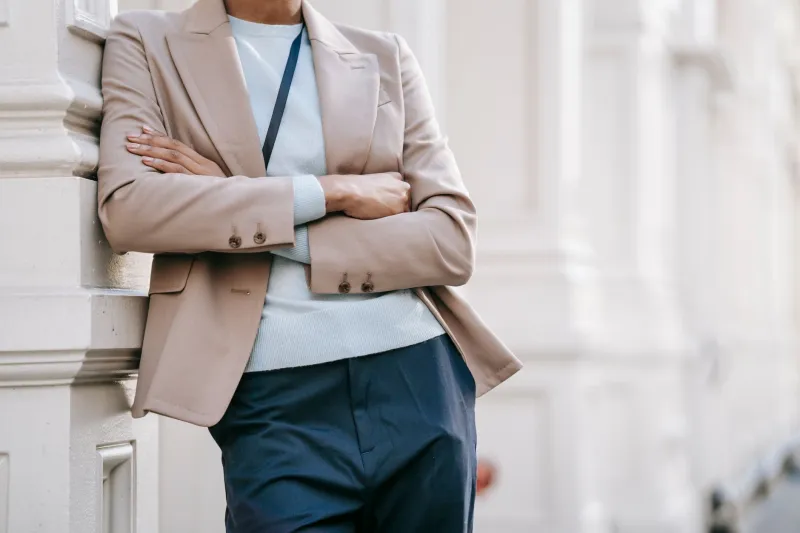
Pick one repeatable element. A signature doesn't have to be complicated. It can be as simple as always wearing a structured blazer, always opting for a monochromatic palette, or always finishing your look with a specific type of shoe. The repetition is the point — it signals intentionality, which signals confidence.
Audit the outliers. Pieces that don't connect to your signature are the ones that tend to make you feel like you're wearing someone else's wardrobe. These are often the items you reach for last, feel vaguely uncomfortable in, and end up second-guessing halfway through the day. Consider whether they're earning their closet space.
Practice wearing things in. This sounds odd, but it's real: confidence in an outfit builds with repetition. The first time you wear something new, you're often still negotiating your relationship with it. By the third or fourth wear, you've settled into it. Give yourself permission to take that time.
The Real-World Version of This
Consider someone like Ina Garten — she's been wearing the same basic formula (dark wash jeans, chambray or denim shirt, loafers) for decades. It reads as completely intentional, completely confident, and completely her. Or think about your most stylish colleague — not the trendiest one, but the one whose look always seems effortless. Chances are they're not reinventing the wheel every morning. They've found their formula and they trust it.
That trust is the secret ingredient. It's the thing that makes a $30 thrifted blazer look like it cost three times as much. It's the thing that makes someone in business casual look like they could command a boardroom.
The Takeaway
Your wardrobe is a tool, not a verdict. No single piece is going to make or break how people perceive you, because what they're actually reading is the whole package — and the biggest part of that package is you, not the label. When you wear something with intention and ease, that registers. When you wear something with uncertainty and discomfort, that registers too.
So the next time you're standing in front of your closet convinced you have nothing to wear, try flipping the question. Instead of asking what outfit will make you look more confident, ask which outfit already feels like you. Start there. The confidence will follow.